

Every day, more than 100,000 people die of aging, more than every other cause of death combined. It is the root cause behind heart disease, cancer, stroke, and dementia, and the single largest source of human suffering on Earth. And yet there is no coordinated, focused effort to actually stop it. The money that does flow into the field mostly chases one disease at a time, or drugs with only marginal expected effect sizes in the best case. As the field has continued to learn about the nature and complexity of aging, we have largely not updated our strategies to maximize progress.
The Longevity Biotech Fellowship maintains a technology roadmap to change that. It lays out alternative paths to traditional pharma and biotech, ones that could genuinely solve aging, not merely delay it by a few years. This roadmap is meant to point talent and funding at the highest-impact opportunities.
Four ways to face aging
Every approach to aging answers two questions. First: do you need to understand aging to beat it, or can you bypass that complexity entirely? Second: are you trying to solve aging outright, or just buy time until we can? Those two questions make a map.
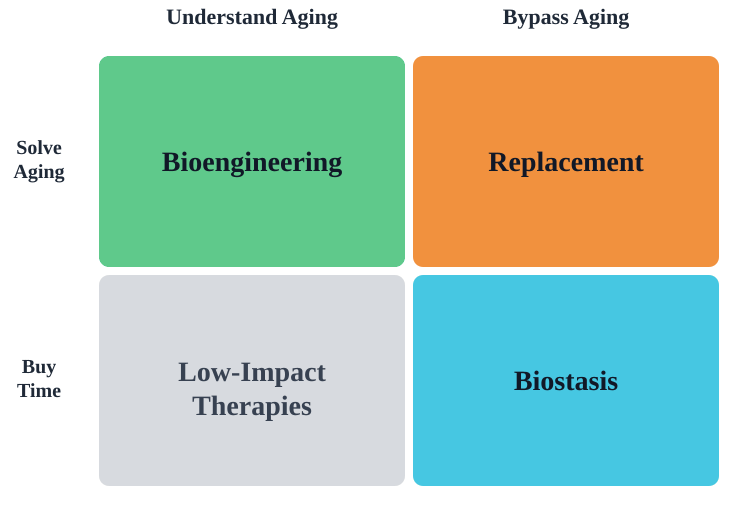
Three of these quadrants are the high-impact strategies the roadmap champions. The fourth is where most of today’s field already sits.
The three primary strategies
Bioengineering: understand aging, then solve it. Re-engineer our own biology to repair the damage that drives age-related disease. The upside is the most complete and scalable answer imaginable, a cure that could one day fit in a routine injections or pills. The catch is that this is by far the hardest and least-understood path, with wildly uncertain timelines for a full solution. On the other hand, incremental progress might lead to “longevity escape velocity”, but we have not yet hit the elbow of that curve and don’t know when we will.
Replacement: bypass the requirement to understand aging, and still solve it by simply replacing old parts with young ones grown in the same way as nature. The upside is that it sidesteps the crushing complexity of aging and the surprisingly daunting challenge of even knowing if your therapies work, and looks like the nearest and cheapest (potentially) complete solution. The catch is that it needs a supply of young tissue, advances in surgery, and the one part you cannot simply swap out is the most important: the brain.
Biostasis: the ultimate approach to “buying time”. Preserve people who are out of options today, to be revived in the future when better medicine can restore them to perfect health. The upside is that it is the only strategy available right now, and a source of hope for those who cannot wait. The catch is that we cannot yet reverse it; for now it is a bet that the future will finish what we start.
The fourth quadrant, low-impact therapies, is the drugs and single-disease treatments that most of the field works on. They have real near-term value but small effect sizes: they might slow aging and even add a few years, but even many of them combined would never come close to solving aging, or even shifting maximum lifespan by much. That is why the roadmap points elsewhere.
Why the strategies are stronger together
We do not know how each of the strategies will play out, what they will take to implement, and how long it will be before we can verify that they work. However, it is likely that many people will need some combination of the technologies from each category, so these are not competing bets. They compound.
Bioengineering makes the other two work better. The same tools that repair aging damage also give biostasis better cryoprotectants and other tools for reversible preservation, and give replacement better-engineered tissue,drug-free immune tolerance, and tools to help enable or complement gradual brain replacement.
Replacement lets bioengineers attack the hardest problem. If you can replace the body from the neck down, the field’s sharpest minds can concentrate their repair work on the one thing you cannot replace outright: the brain.
Biostasis is everyone’s lifejacket. If a body transplant or a bioengineering cure is not ready in time, biostasis buys the years needed for it to arrive. It catches the people the other paths cannot reach in time.
Together they form a portfolio: parallel routes to the same destination that de-risk each other, so a stall on any single path does not doom the mission.
Where you come in
No one is coming to solve this for us. The roadmap is only as fast as the people working it, and the biggest bottleneck today is not which strategy to pick, it is that far too few people are working on any of them.
That is the whole point of the Longevity Biotech Fellowship. Whether you are a scientist, an engineer, an entrepreneur, or a funder, there is high-leverage, wide-open work waiting on every one of these paths. Join the fellowship and help us create a world where aging is a thing of the past.